Question:
You teach us that we should increase our tolerance, but if someone is
doing wrong with me, should I practice forgiveness, or should I oppose
him and stop the atrocity?
Answer: On
the spiritual path, we naturally learn to practice tolerance,
forgiveness and humility. However, this does not mean that we should
knowingly allow others to exploit us. The scriptures instruct us to take
whatever action is necessary, for protecting ourselves in self-defense,
when attacked.
There
is a charming story in this regard. In a neighborhood, there lived a
venomous and foul-tempered snake. The children of that locality were
scared of it to death. The moment they would spy it in the distance,
they would run for their lives
One
day, Sage Narad Muni happened to come to that neighborhood. As was the
snake's habit, he approached Narad ji, with his hood raised menacingly
and eyes fiercely red. Narad ji stood his ground peacefully, with a
benevolent and serene smile on his face. The snake was astonished.
"Everyone runs from me in fear. How come you are not scared of me and
what is the secret of your peacefulness?"
Narad
ji taught the snake the process of devotion, whereupon the snake became
his disciple and began practicing Bhakti. He shunned violence, giving
up his old ways of scaring the neighborhood children.
Soon
the children came to know that the snake was harmless and did not bite
anyone. Now their fear vanished. They would not leave it alone. On
sighting it, they would bombard it with a battery of stones and sticks.
They would even come close and kick it with their heeled shoes. The
poor snake was badly bruised.
One
year later, Narad ji was visiting that area again. He thought, "Let me
see how my disciple is doing." He was dismayed to see the snake badly
bruised, with a plaster cast on a portion of his body. "What happened to
you, my dear disciple?" he asked.
The
snake replied, "O Gurudev, this is the result of the Bhakti that you
taught me. The people of the world, knowing I will not retaliate, do not
let me live peacefully."
Narad
ji said, "I asked you to stop biting people, but I did not ask you to
stop spreading your hood. Whenever the children attack, you should
simply raise your head and hiss loudly; then no one will come near
you."
Henceforth,
whenever the children came close to the snake, it would hiss loudly and
frighten them all away. Soon, it was living peacefully again.
Similarly, on the path of devotion, we should shun actions and thoughts
directed at harming others, but we definitely have the right to perform
legitimate actions in our self-defense.
Question: When anyone criticizes me or gets annoyed with me, it disturbs me to no end; so much so, that sometimes the whole day is spent in brooding. How can I insulate my mood from fluctuations based on the behavior of others?
Answer: The solution is to develop a better understanding of the world, based on scriptural knowledge. The Vedas say that this material energy, Maya, consists of three guṇas: sattva guṇa, or the mode of goodness, rajo guṇa, or the mode of passion, and tamo guṇa, or the mode of ignorance.
Everyone's mind too is made from Maya, and so the three modes of Maya exist in the mind as well. Depending upon the environment and where we focus our thoughts, one of the guṇas becomes prominent and our mind takes on that quality. If sattva guṇa dominates, one becomes peaceful, contented, generous, kind, helpful and serene. When rajo guṇa gains prominence, one becomes passionate, agitated, ambitious, envious of others success, and desirous for sense pleasures. When tamo guṇa becomes prominent, one is overcome by sleep, laziness, hatred, anger, resentment, violence, and doubt.
For example, let us suppose you are sitting in your library, engaged in study. There is no worldly disturbance, and your mind has become sāttvic. After finishing your study, you sit in your drawing room and switch on the television. Seeing all the imagery makes your mind rājasic, and increases your hankering for sense pleasures. While you are watching your favorite channel, your family member comes and changes the channel to her liking. This disturbance causes tamo guṇa to develop in your mind, and you are filled with anger. In this way, the mind sways between the three guṇas, and takes on the corresponding qualities.
This fluctuation takes place constantly in everyone's minds, altering their thoughts amongst the three modes. When two people's guṇas are divergent, their ideas, interests, desires and tastes also become divergent, and that causes strife. This strife exists everywhere, between husband-wife, father-son, brother-sister, friend-companion, and so on. Congruence can happen only when two people have the same guṇas. However, since everyone's guṇas are fluctuating, it is unreasonable to expect that the other person's guṇas will constantly match ours.
The reason for our anxiety is that we have unreasonable expectations. We want others to always think in the same manner as we do. And when this does not happen, we get disturbed. Instead if we could realize that invariably people will have views differing from ours, and this is very natural due to the three modes of material nature, we will not be disturbed when they oppose us or criticize us.
So by increasing our understanding of the world, we can insulate ourselves from the fluctuating moods of others.
We all have a mind that is responsible for all the actions that we perform. Firstly, it is the mind that constantly creates desires. The question is, why do we have desires? This is because, all souls desire true happiness, i.e. happiness associated with God. To fulfill this natural desire for Bliss, the mind constantly creates 'desires' every moment. There are five types of desires - the desire to see, desire to hear, desire to smell, desire to taste and desire to touch or feel.
The mind desires to enjoy subjects related to these five senses, and it can desire for objects only in two areas - either related to God or related to maya, the material world. Hence, this mind can either desire for God or for material objects. There is no third area where the mind can seek for happiness.
If we believe that happiness can be achieved from this material world, we will aim to fulfill our desires in this realm. If we believe that happiness can be achieved from God, we will automatically desire to attain Him. This is a natural tendency and not learnt from anyone. Not just humans, but even animals and birds have this innate understanding. The mind works in accordance with the decision of the intellect, and has to desire what the intellect thinks is the source of true happiness.
svatantraḥ kriyamāṇe vai kṛito bhagavatā vidā
The material world is readily visible, but God is not easily seen. It is the nature of the mind to desire material pleasure, as it is made of the same elements (Panchmahabhut) that constitute the material world. It is very natural and easy to get attracted to things that we can see, and we can see this material world and not God. Although the Vedas, Shastras and Puranas praise God, and the message is repeated by the saints, our mind is not able to concentrate in that direction. The mind is easily attached to material objects of pleasure, and seeks happiness in them.
Our experience of this world has taught us that there is no real happiness in material objects. Initially, we may derive a lot of pleasure, but with time, happiness disappears. We might have embraced our dear ones - mother, father, son, daughter, husband or wife thousands of times and cherished our favorite Indian sweet - rasgulla thousands of times, but we still remain tensed and disturbed. We have not achieved eternal peace or happiness from any of them. Our ultimate goal is to find happiness but our experience seems to be the opposite.
We think that the attainment of a material object or a person will make us happy. But when we get it, we no longer derive happiness from it. We get disturbed because that object no longer provides the same level of happiness as before. We have all experienced this before, across countless lifetimes. It is the intellect that must decide that the material world has been created for the body, and not to provide happiness for the soul.
surapati brāhmaṁ padaṁ yāchate
This disease of desire affects even celestial personalities. This quote above says that the king of heaven, Lord Indra desires for the seat of Lord Brahma. What about humans? We wish to earn millions or become the Prime Minister of India. This is the limit of our desires. What else we can desire? But even the king of heaven Indra has desires. Lord Indra has the ability to get whatever he wants by just wishing for it. He has Varun, Kuber and Yamraj as his servants. Yet, he has desires. Why? It is because he is still deprived of the love of God. He did not attain the happiness related of the soul.
On the occasion of Radhashtami, watch a special video of Swami Mukundananda explaining a Divine childhood pass-time of Shree Radharani. CLICK HERE
Friday, August 19, 2011
Swami Mukundananda Leads the “The Path to God Realization”
HOUSTON: Swami Mukundananda, a well renowned saint from Vrindavan, U.P, India makes a much awaited return to Texas as part of his enlightening tour across USA. He has pioneered the ground breaking, “Jagadguru Kripaluji Yog” – a holistic system of Yoga that incorporates physical, mental, intellectual and spiritual health of humankind. The highly educated spiritual leader’s teaching is scientifically explained as “the spiritual art of managing the mind”. He brings a powerful combination of yoga, meditation and spiritual wellness to the fore through a series of discourses and practical training sessions.
Swamiji teaches the true philosophy of God realization by practice of sincere devotion as per the Vedas, Upanishads and other sacred texts. In order to achieve this goal, a healthy body and mind is absolutely essential. His programs imbibe the age old traditions of Yoga, Meditation & Pranayam to purify the body, and Divine knowledge to cleanse the mind, leading to the true upliftment of the soul.
Jagadguru Kripaluji Yog has organized a series of Yoga, Meditation, and spiritual discourses in more than 27 cities across USA this summer. Led by Swami Mukundananda, these programs kicked off in April 2011 at Irving, TX and have enthralled audiences all over the country. After a whirlwind tour of 13 states, Swamiji will be in Sugar Land and Houston in late August for his hugely popular series of Yoga, Meditation and lecture programs.
Speaking at the hugely successful program in California this summer, Laura Fine remarks, “Swami Mukundananda is continually inspiring. I love the yoga as it takes me deep inward and prepares my body to be able to relax into a devotional stillness where I can focus deeply inward and absorb the chanting and philosophy that follows. I can’t wait to return for more.”
Swami Mukundananda’s sessions have drawn ever increasing crowds year after year. The list of cities he has visited has steadily increased from 10 in 2009 to over 25 in 2011. Swamiji has also pioneered a special educational program for children, Bal-Mukund, aimed at developing moral and spiritual values in youngsters. The program helps nurture a child’s personality by strengthening their basic character and providing a stronger platform to face the challenges of the modern world.
His awe inspiring talk on “Wellness for Life” at Oracle HQ in Redwood Shores in late April 2011 was an instant hit with the audience, who learnt about new ways of understanding the quest for happiness in an increasingly stress filled environment. Not to be left out, it was Google’s turn to invite Swamiji at their Headquarters in CA in May 2011 to hear his masterly lecture.
During his tour of USA in 2010, Swamiji was the guest speaker at the prestigious Princeton University, New Jersey, Kellogg’s School of Management, IL, University of Illinois, Chicago and Northeastern Illinois University.
What has inspired and impressed people across the table is his simple but highly effective logical explanation about human values and their inner quest for happiness. People have been touched by his very presence and his scholarly wisdom. His humble and approachable nature has appealed to people from all walks of life.
Kelly Carrasquillo, (CT) says, “Brought to tears when witnessing the devotion and harmony Swamiji brought out in everyone. Regardless of religious background Swamiji’s lectures got to the core principle of each faith.”
Uplifting! Excellent! is what people who have been touched by the words of wisdom and the personality of Swami Mukundananda have been saying. In every city of his visit, a week-long program with Yoga sessions in the mornings and/or evenings is organized. The first part of the session focuses on Yoga & Meditation. The second session focuses on devotional chantings and spiritual discourses to purify the mind.
Swamiji was recently invited to the Hindsdale Community Center, IL for a workshop on “Stress Management in the 21st Century”. A huge hit with the audience for the highly practical techniques to counter mental stress, the participants were highly appreciative of the values and the learning they were exposed to in such a short timeframe.
Swami Mukundananda’s programs in Sugar Land and Houston, TX start on the 21st of Aug and will run till the 1st of Sep, 2011. The program will include yoga, meditation, spiritual discourses and chantings. Program admission is free. Program details can be viewed at: http://jkyog.org/event_tx.html
His East Coast, West Coast and Central Tour was a huge success followed by a spiritual retreat in Fresno, CA on Memorial Day weekend, and in Danbury, CT during the 1st week of July. The testimonials of attendees showed how the 2 day retreat changed their lives and they will continue to attend it every year. Many are now planning to attend the final retreat at Trinity, TX on Labor Day weekend.
Many participants and devotees feel enlivened by Swamiji’s life transforming techniques. Swamiji has made a tremendous impact on thousands of people who came to see and hear him speak at the various venues across the country.
Swami Mukundananda received his degrees in Engineering and Management from two world famous institutes in India- Indian Institute of Technology (IIT) and Indian Institute of Management (IIM) respectively. However, the call of God was so strong that a short while after landing a top corporate job, he renounced his professional career to take sanyas, in the quest for God-realization. Since the last two decades, Swamiji has been travelling far and wide in various states of India and also in Nepal, Singapore, Malaysia, Hong Kong, USA, and Europe, awakening hundreds of thousands of seekers.
About Jagadguru Kripaluji Yog (JKY)
JKY is a non-profit organization dedicated to the spiritual, mental and physical wellness of Humankind, through true Yoga and Spirituality. For more information, visit http://www.jkyog.org/2011or email secretary@jkyog.org or call 323-286-0452
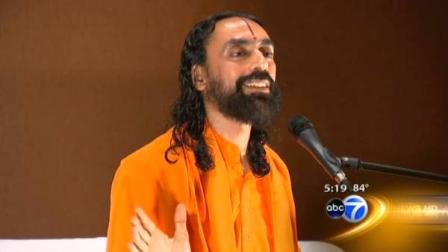
August 7, 2011 (ROLLING MEADOWS, Ill.) (WLS) -- One of the world's spiritual leaders is bringing his message to the northwest suburbs.
Swami Mukundananda spoke Sunday at the Meadows Club in Rolling Meadows. He is known for offering new ways of understanding both Eastern and Western scriptures.
Stress Management in 21st Century
A relaxation workshop by Swami Mukundananda
DATE : Sunday, August 11, 2011,
TIME : 4 PM - 8 PM (Details below)
LOCATION : Hinsdale Community Center
415 W 8th St, Hinsdale, IL 60521
Limited Seats. Please Register to secure your place
OVERVIEW::
While modern technology like cell phones, emails and social networking are designed to make life easier and more fun, most of us are getting increasingly stressed out. The impact of stress is cumulative and leads to a gamut of negative emotions like tension, fear, distress, apprehension, and anxiety. On the
physical level, it causes health problems such as headaches, acidity, ulcers, high blood pressure, and heart disease.
In his talk, Swami Mukundananda will delve into the causes for the development of stress, and reveal practical techniques of stress management by applying ancient Indian philosophies to daily life, and explaining the healing art of subtle body relaxation.
4:00 - 4:30 (Registration and Welcome)
4:30 - 7:00 (Discourse and relaxation workshop)
7:00 - 8:00 (Networking and refreshments)
Contacts:
Ray Mehra : 630-258-4000
Gopal Gehi : 630-740-1757
Ankur Gupta : 224-645-2621
Tarun Kumar: 637-877-7980
Limited Seats. Please Register to secure your place
I am happy to have found a Divine Love Family this past retreat, though Path is walked alone with assistance of a true guru as Swamiji said in class. After two days of the program I have become aware of all the inner healing I've been going through this past weekend. Radhey Radhey
Oscar Martinez
............................................
It was truly beautiful and I was so grateful for the opportunity. What an amazing spiritual community and the most amazing Guru Swamiji.
Jessica Grant
............................................
Thank you Swamiji for sharing and welcoming us Westerners with open heart and mind. It was a truly moving, hopeful and promising experience to see the different faiths come together as one cohesive Bhakti rhythm. I want to also personally thank you and the rest of the family for your concern and healing thoughts! It was your care that pulled me through the remainder of the retreat. I am forever in gratitude. Immensely grateful to have been blessed with the opportunity to attended this retreat. The wisdom and compassion you shared with us are beyond measure.
Kelly Carrasquillo
............................................
I am humbled in your presence, Swamiji. It was three days filled with Divine Knowledge, devotion and love. Your desire to share this knowledge, and your tireless efforts are such a gift to us. I hope that many other Westerners are also able to hear these teachings and experience your joy.
Question: When God is the actual Doer, why are the souls subjected to the results of their karmas?
Answer: Many people diminish the need for self-effort in their minds by saying, "Nothing is in our hands. God is seated within us. He is the doer of all our actions, and we act as He inspires us." However, this philosophy is not really true, as the following points will illustrate:
If God were the doer of all our actions, we would never have committed any mistakes. All of our works would have been perfect, since God can never make a blunder. The fact that we make innumerable mistakes implies that we are performing actions with our own free will.
If God were the doer of our actions, we would not have to bear the karmic reactions. Why would we suffer for works that God did through us? He would either bear the karmic reactions on His own, or forgive Himself. But there is the Law of Karma, "As you do, so you shall reap." This implies that we ourselves are responsible for what we do.
God is impartial towards all souls and perfectly just. If He was the doer of our actions, He would either have made everyone do good works and become Saints; or He would have made everyone do bad works and become demons. But there is so much of variety in the world. One is a Saint, like Prahlad, while the other is a demon, like Hiranyakashipu. This variety implies that we have the freedom to choose our own actions, and we are responsible for them, not God.
If God were the inspirer of our actions, there would have be no need for Him to reveal the Vedas or any other scriptures. There would be no need for Him to explain to us the path to perfection. He would simply have to say two sentences: "O souls, I am the doer of everything. So you do not have to understand what proper and improper action is."
It is true that God is seated within us, and He gives us the power to act. However, what we do with that power is decided by our own free will. This is just as the powerhouse supplies electricity to your house. If it did not give the power, you would not have been able to use any electric appliances in your home. However, once you do have that power, what you do with it, is your own choice. You could operate the fan, light the lamp, or heat/cool the house, as you wish.
Similarly, God gives our eyes the power to see. If He did not give us this power, we would not have been able to see anything. But once we do have this power, what we see is in our own hands. You could go to the temple and see the Deities, or you could see dirty pictures on theinternet. God is merely giving you the power to see. What you decide to see is your own choice decided by your free will.
Hence, we must not blame God for our mistakes.If we do something wrong, we should take responsibility for the error and strive to correct it.